
TIDE
Threat Informed Detection Engine
If an adversary attacked today, would your rules actually catch them? TIDE answers that question per system you defend: which threats your detection rules cover, which of those rules can still work on the data you collect, and who accepted every gap that is left.
Latest release 6.4.0 Open source, air-gapped, and two Docker containers to run.
What TIDE does
Rule Health
Every rule from your SIEMs in one place, scored as a percentage on the checks you choose and weight per client: field mappings checked against your real indexes, investigation guides, MITRE tags, search time and more. Filter, validate, and see each rule's score over time.
Rule Monitoring
Kibana says when a rule fails. TIDE says when it quietly can't work:
- missing indexes and fields, failed runs, blind windows
- data gone quiet, fields never filled, events arriving late
- noisy, silent and spiking rules, slow searches
- exception sprawl, duplicates, upstream drift
Effective coverage
Systems and baselines show what each environment should detect and what covers it. Effective coverage leaves out rules that can't work right now, so a green tick means a rule that can still fire. Known gaps carry a reason, an owner and a review date.
Threat informed baselines
Build a baseline from any ATT&CK group, software or campaign, or from your OpenCTI's intrusion sets, then map rules to each technique. The heatmap and Threat Landscape show how much of each actor's tradecraft your enabled rules carry.
Sigma and Elastic libraries
SigmaHQ and Elastic's detection rules are built in. Filter to what you need, convert and deploy in a click, or make a baseline from the rules you filtered. TIDE tracks where each rule came from and shows you upstream updates to review and merge.
The rule lifecycle
Create and edit query, EQL, ES|QL, threshold, new terms and indicator match rules. Duplicate, move or copy them between SIEM destinations, compare two rules section by section, and see every change in a rule's history, whoever made it and wherever.
Reports and GitLab
Executive and technical system and threat reports in PDF or Markdown, with the health of the rules behind the figures. Back up every rule to GitLab, and raise Rule Monitoring's findings as GitLab issues for the person who fixes them.
Built for secure networks
No internet needed once installed: MITRE ATT&CK, NIST 800-53, SigmaHQ, Elastic's rules and the CISA KEV catalogue ship inside the image. Each client gets its own database, users and roles, with Keycloak single sign-on and an out-of-hours maintenance window.
Platform screenshots
A demo client, Olympus Freight, whose detection rules were written by the Olympians. Some of them better than others. Click a screenshot for the full size.
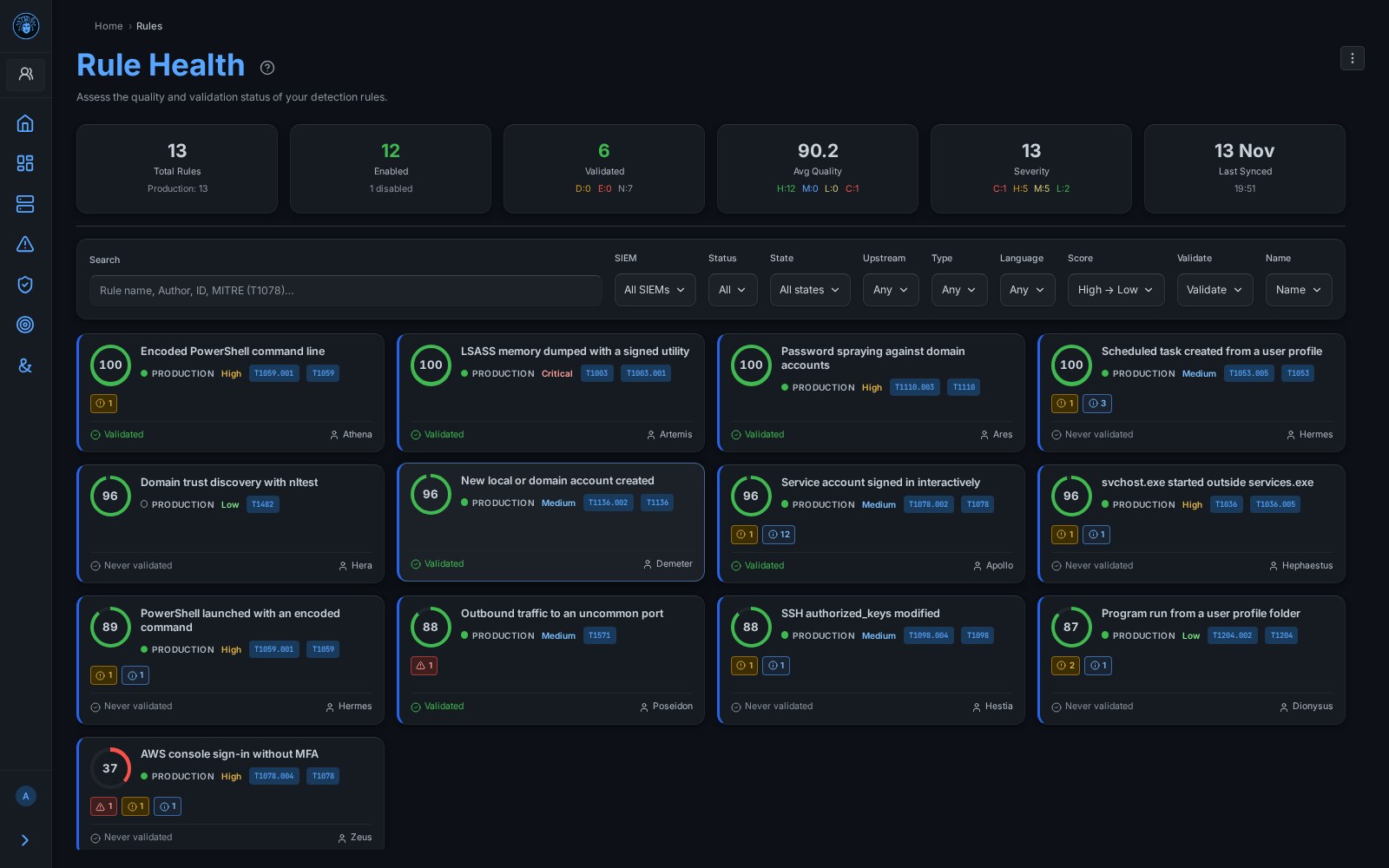
Rule Health: every rule, scored
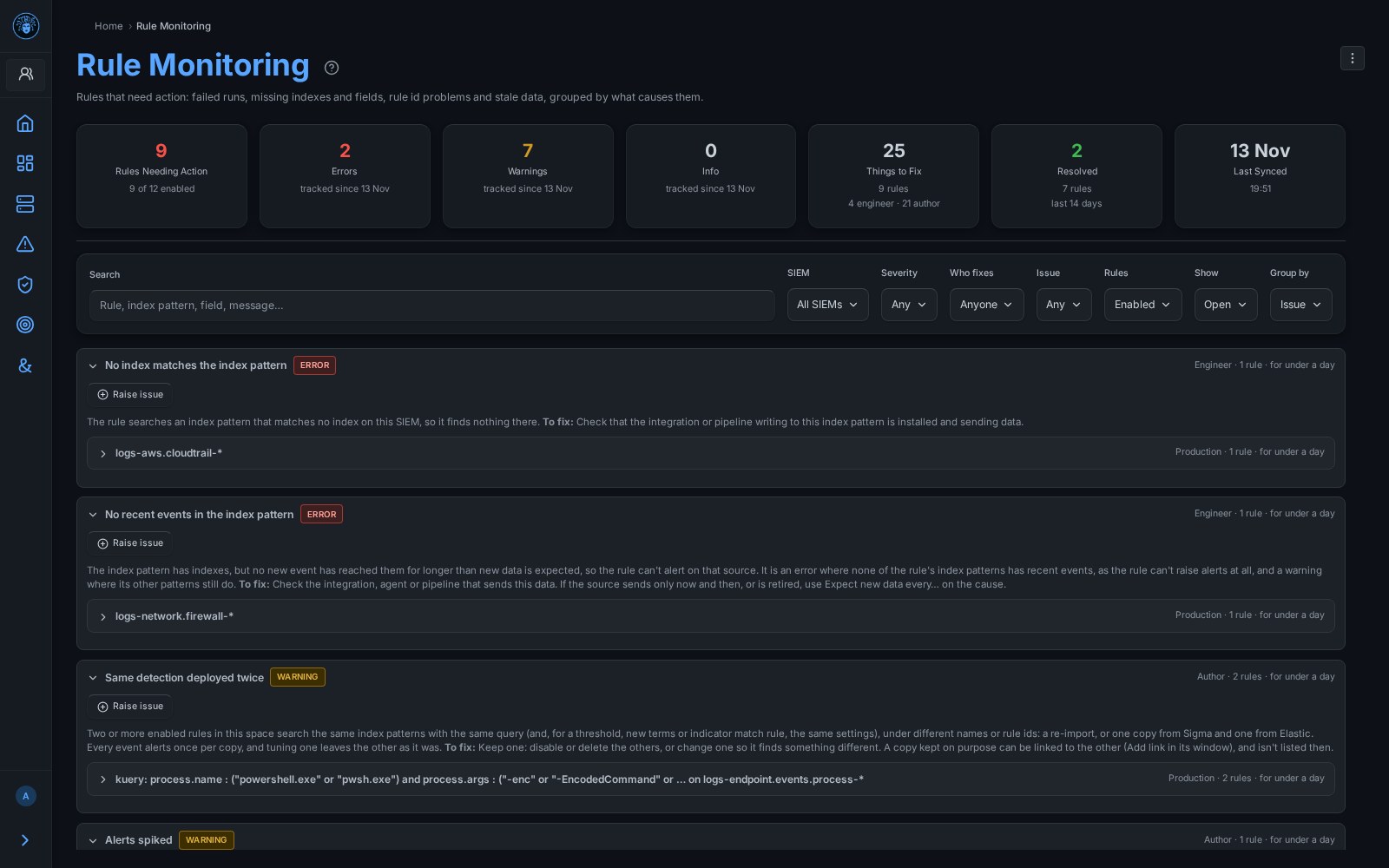
Rule Monitoring: what stops each rule working, by cause
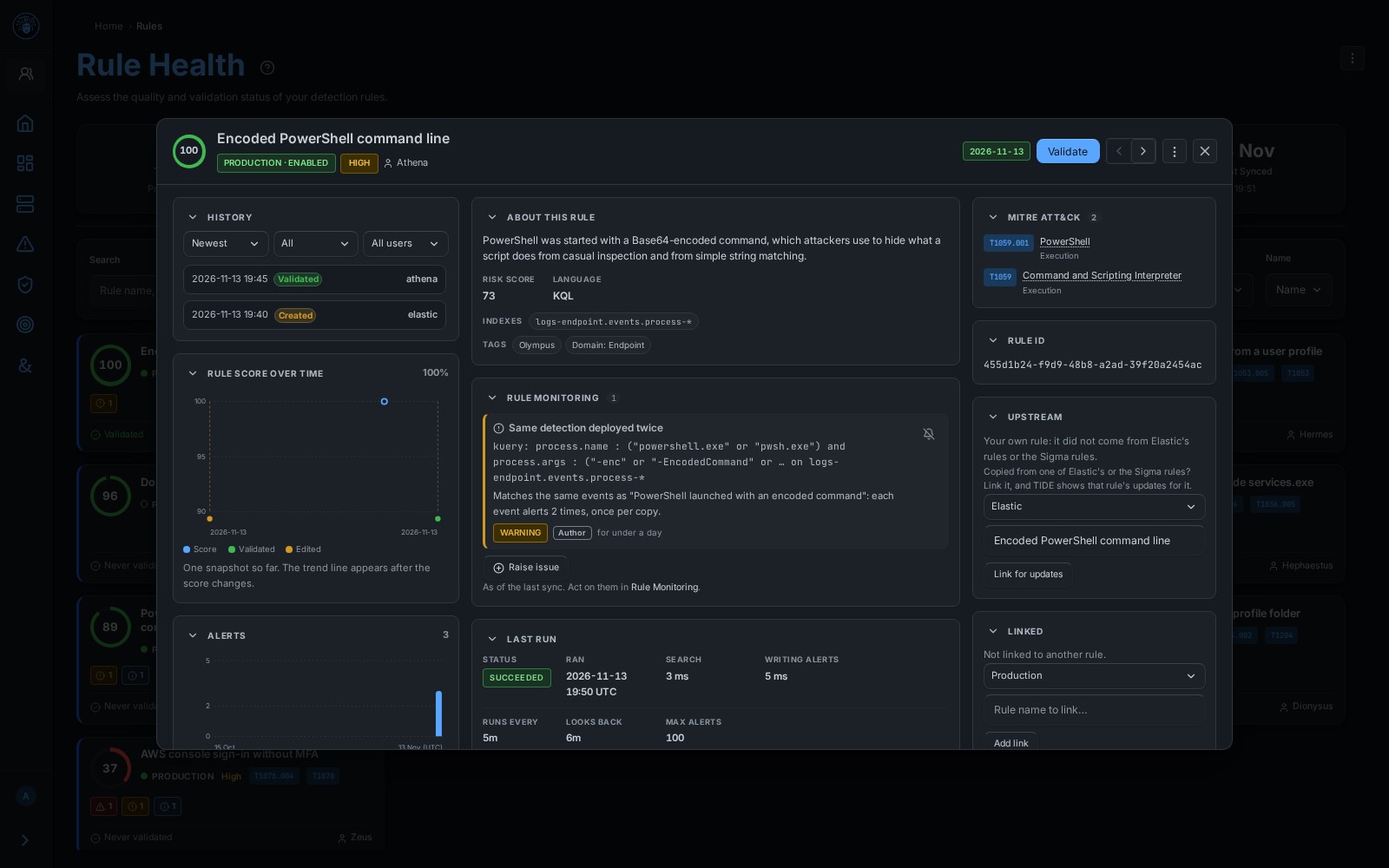
A rule's window: score, alerts, findings, history
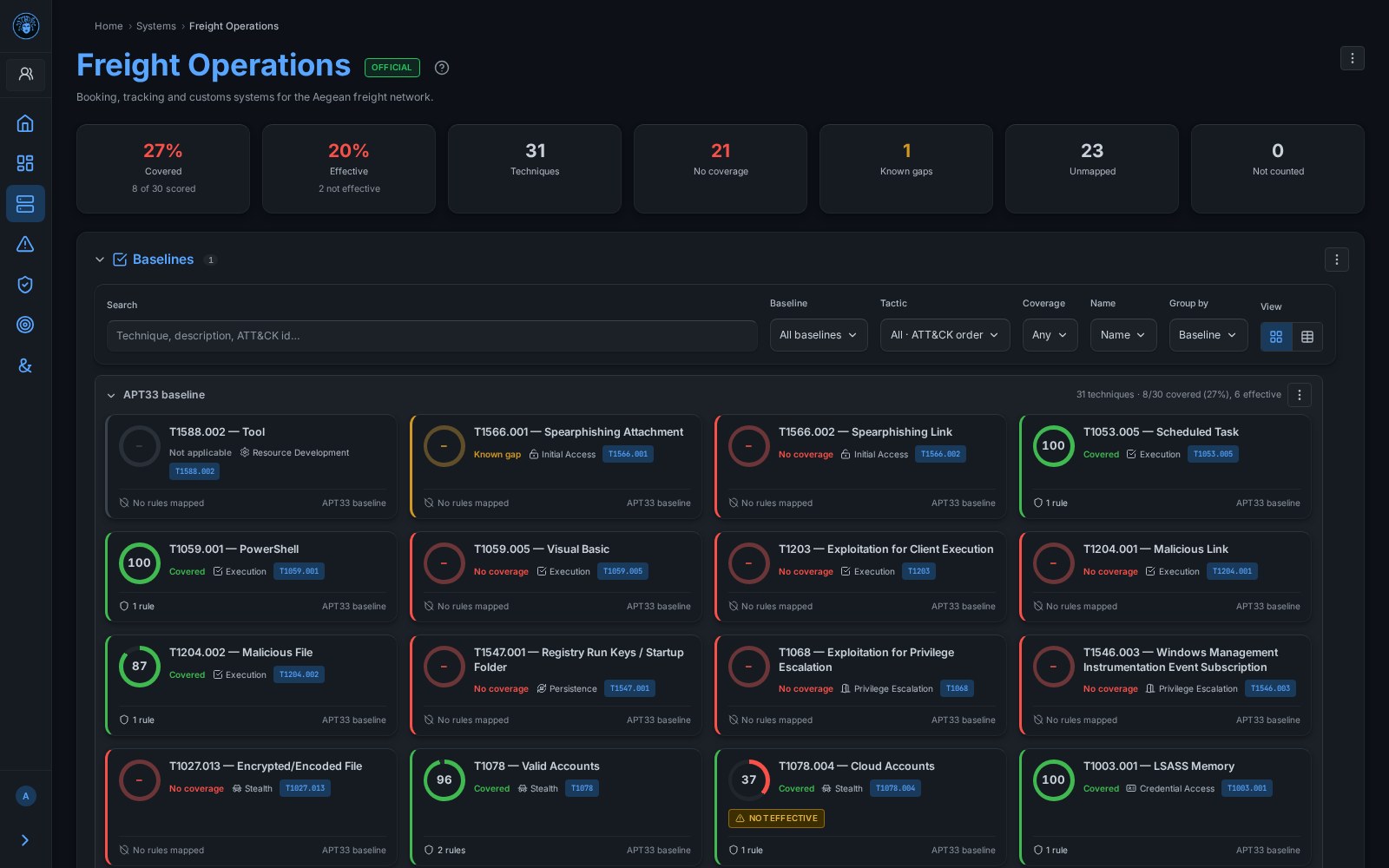
A system: Covered against Effective coverage
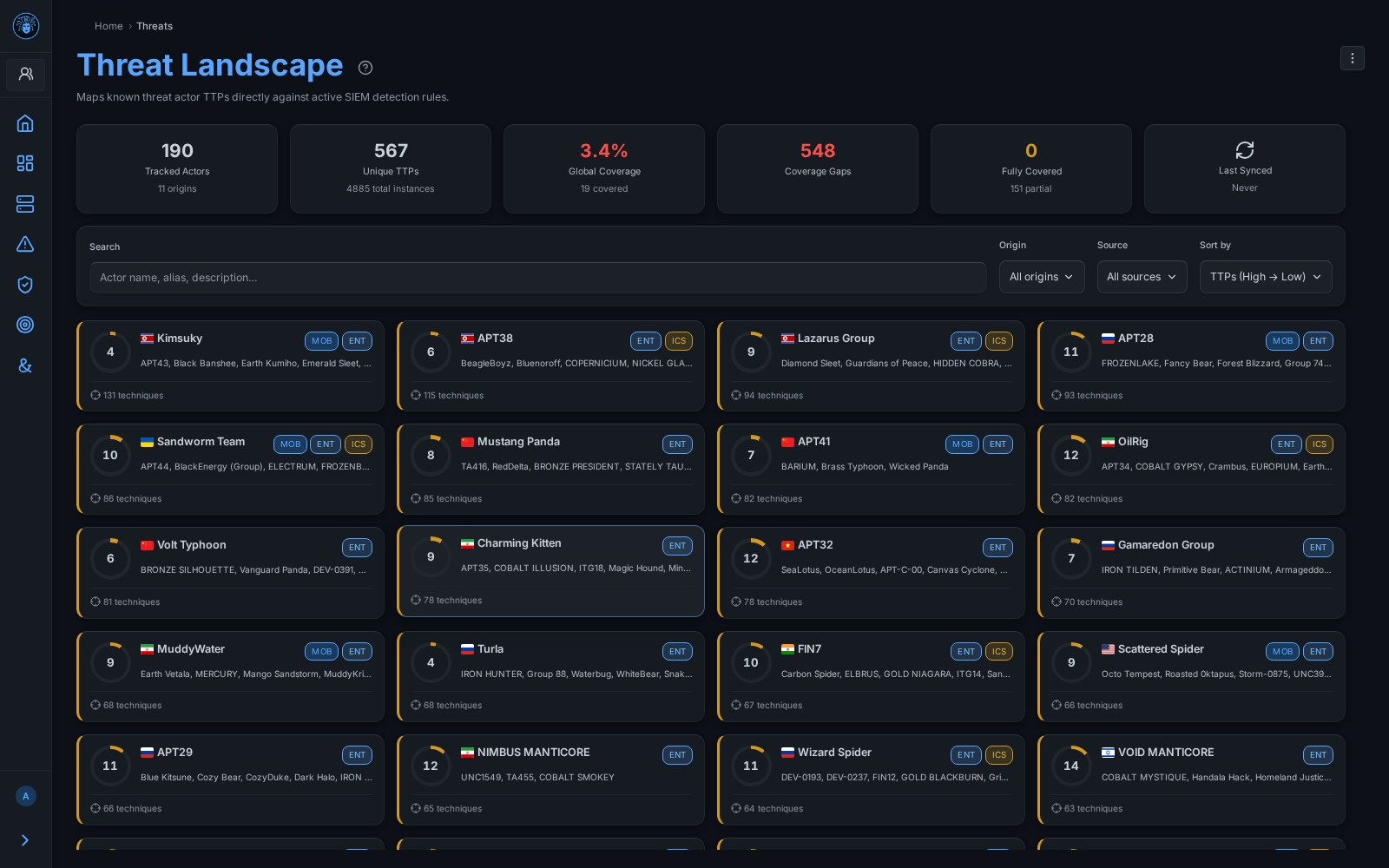
Threat Landscape: coverage per threat actor
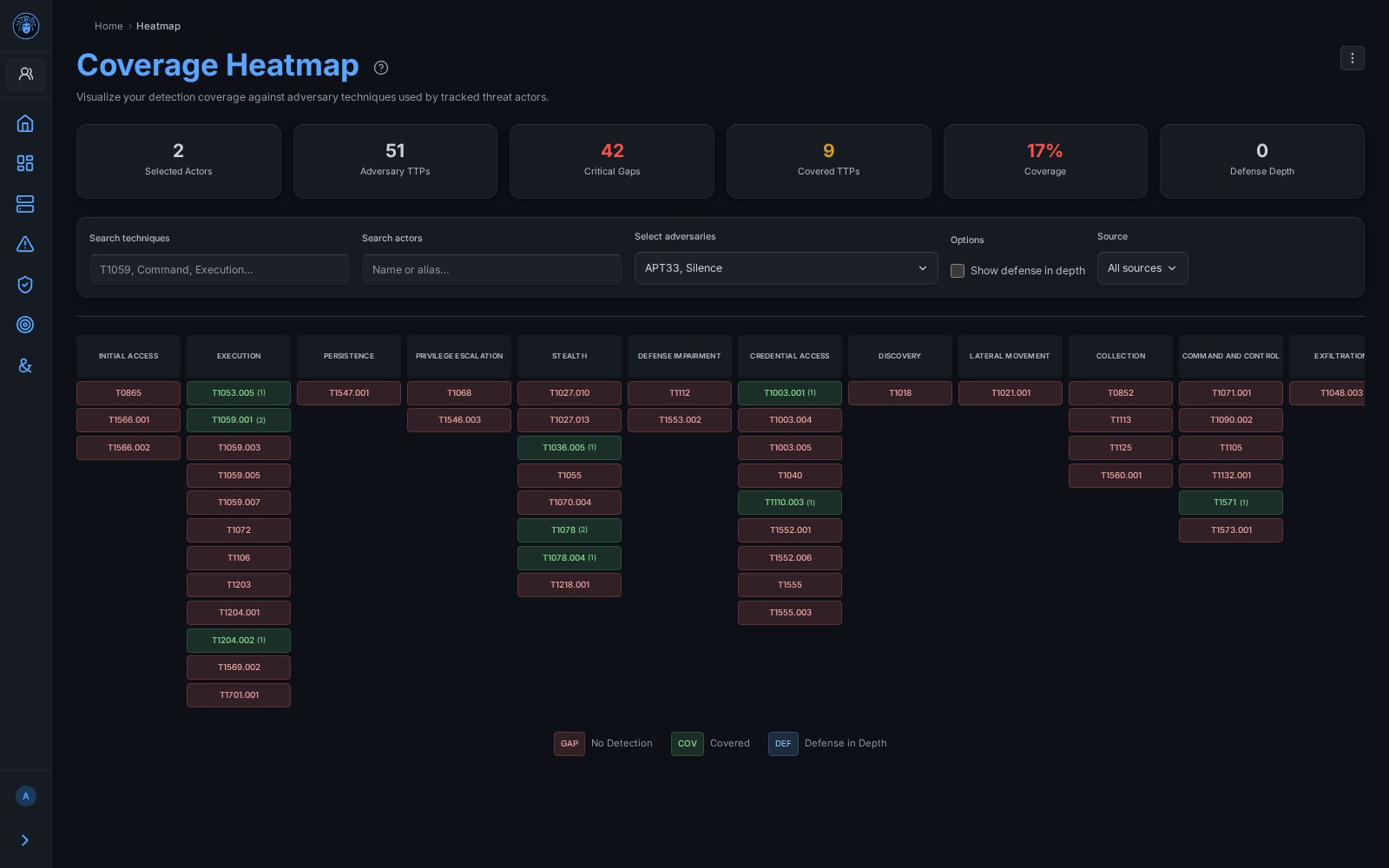
Heatmap: two actors against your enabled rules
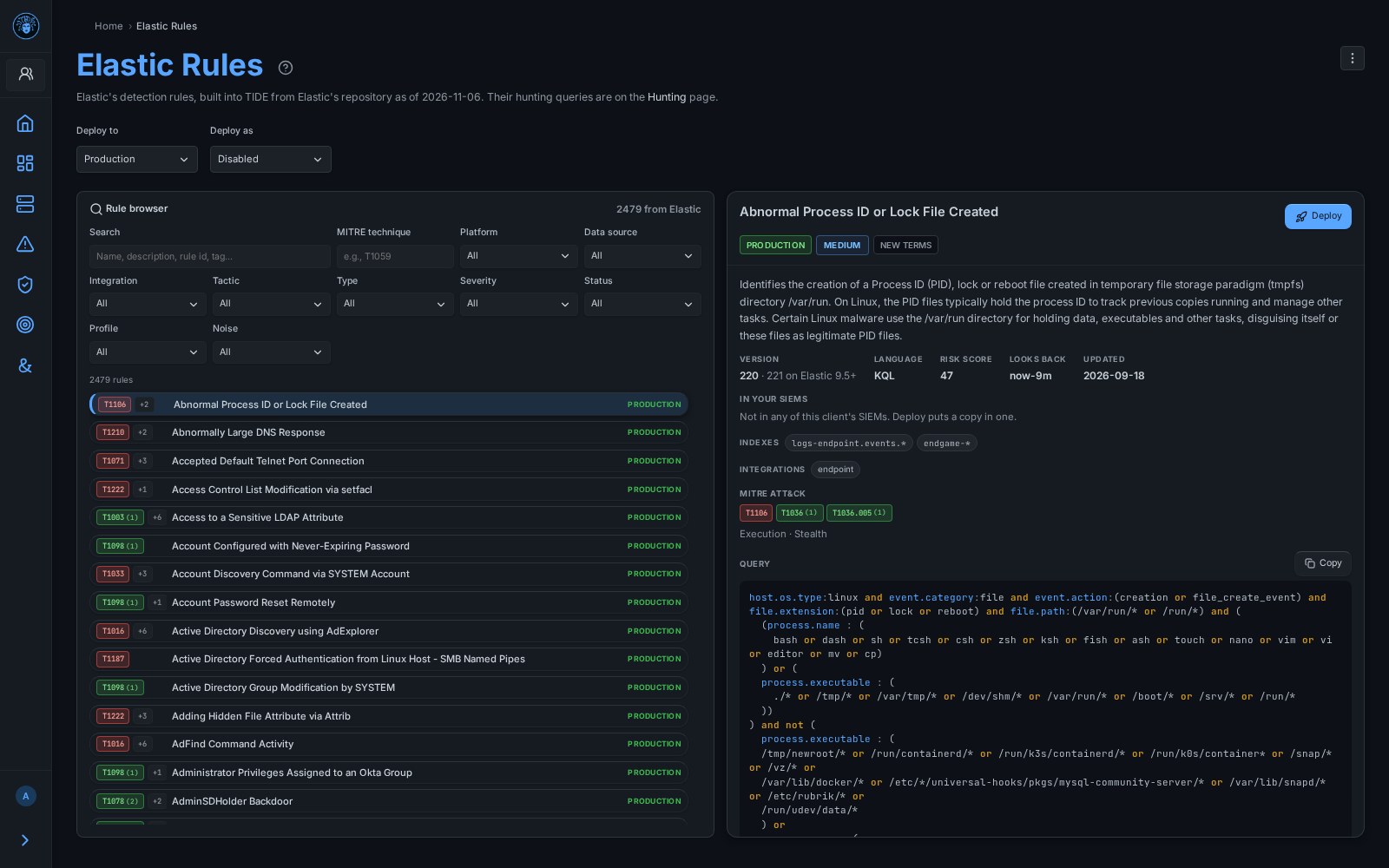
Elastic's rules, built in, ready to deploy
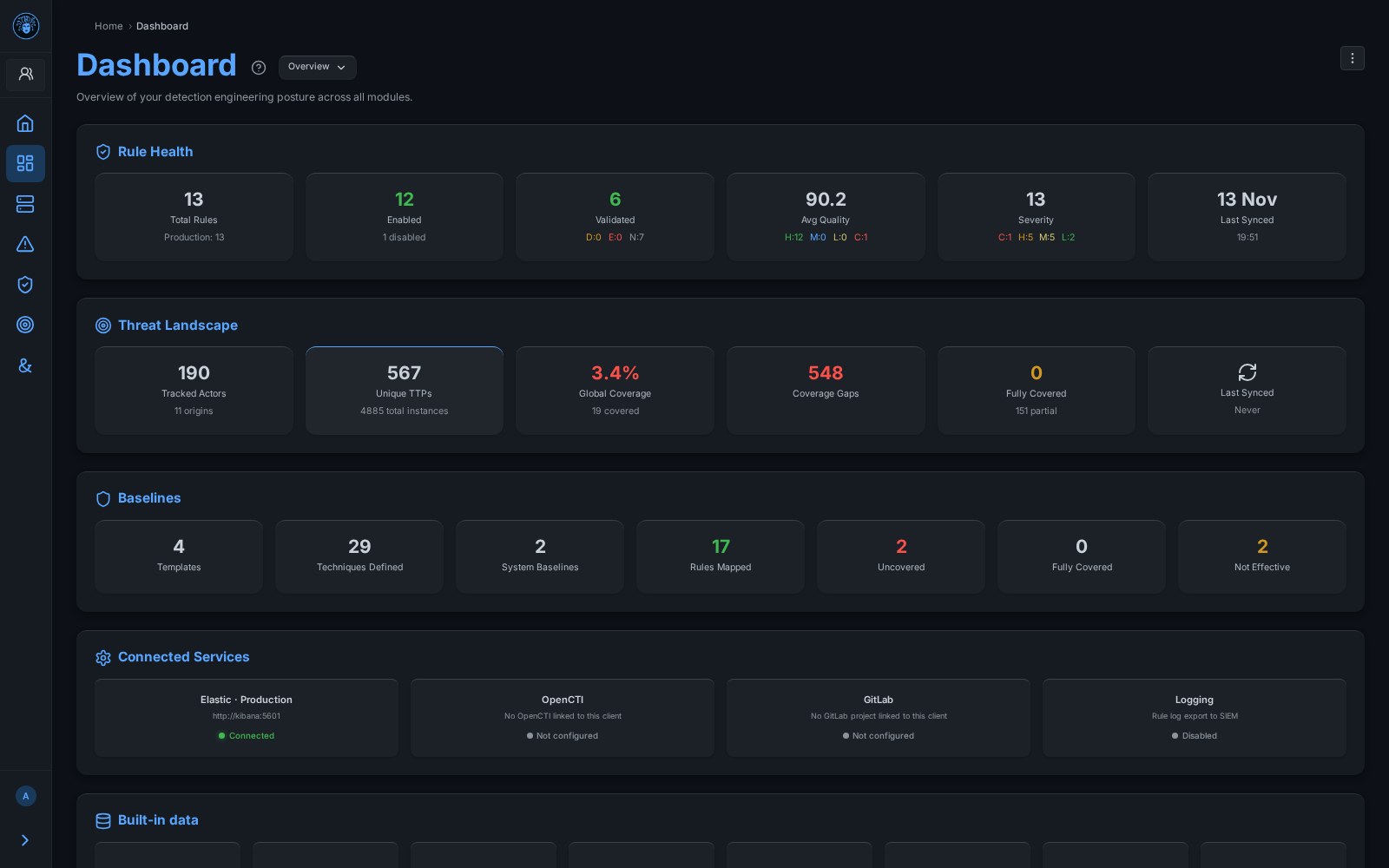
Dashboard: the figures you choose
Coming in 7.0 Preview
Being built now, and subject to change before it ships.
Wazuh
Wazuh rules and alerts beside your Elastic rules, Wazuh agents as a system's devices with their vulnerabilities, and CIS benchmark hardening shown next to coverage.
How to detect
MITRE ATT&CK's own detection strategy in every technique window: what to look for on each platform, the log sources and events to collect, and what to tune.
Log sources per system
Every log source a system's baseline needs on its platforms, from its devices, ready to hand to whoever runs your logging.
What needs you today
A home page of what needs attention: Rule Monitoring's errors, known gaps due for review, lapsing validations and open issues. Plus Elastic's own rule validator, and mapping rules to techniques by their ATT&CK ids in bulk.
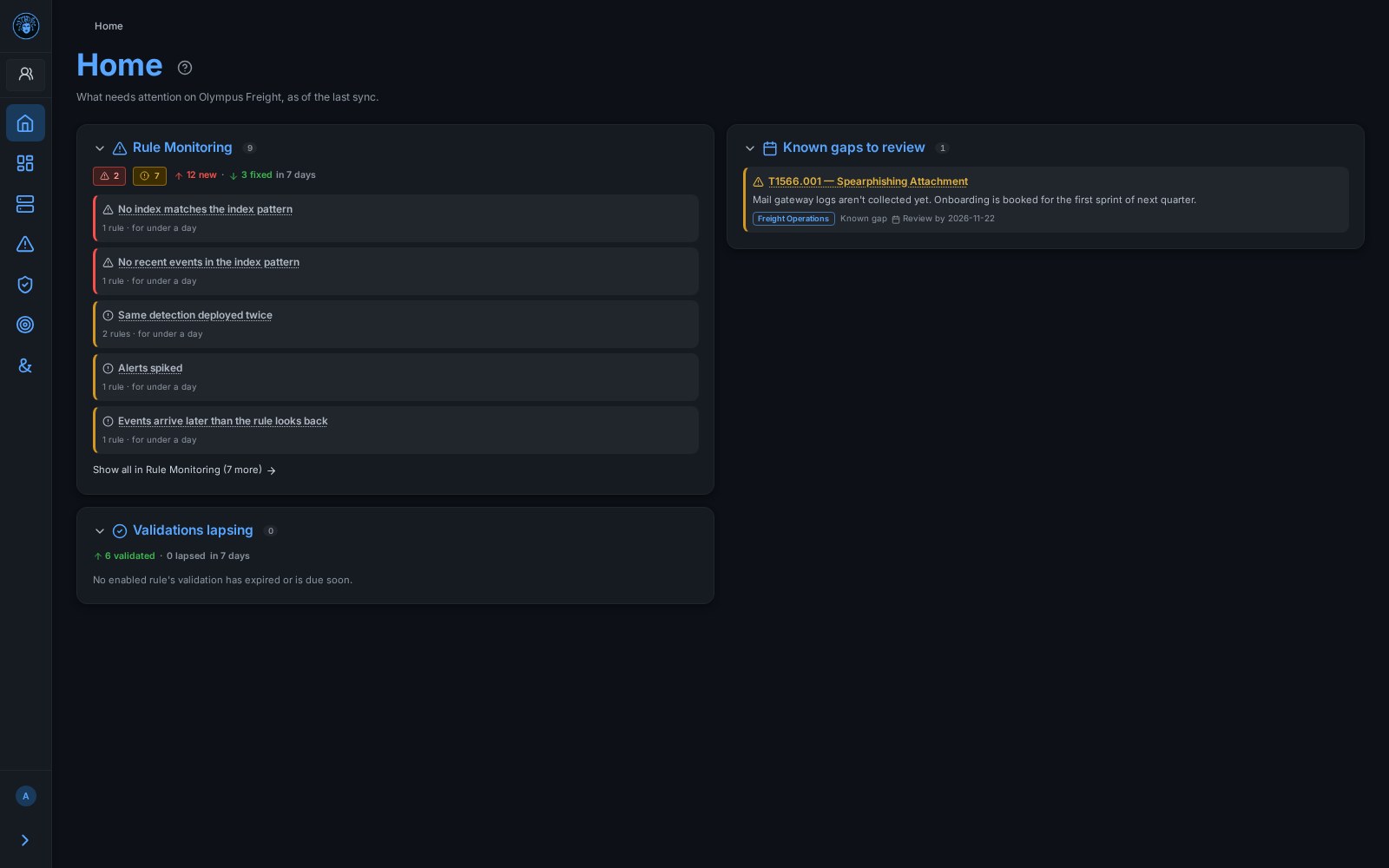
Home: what needs attention
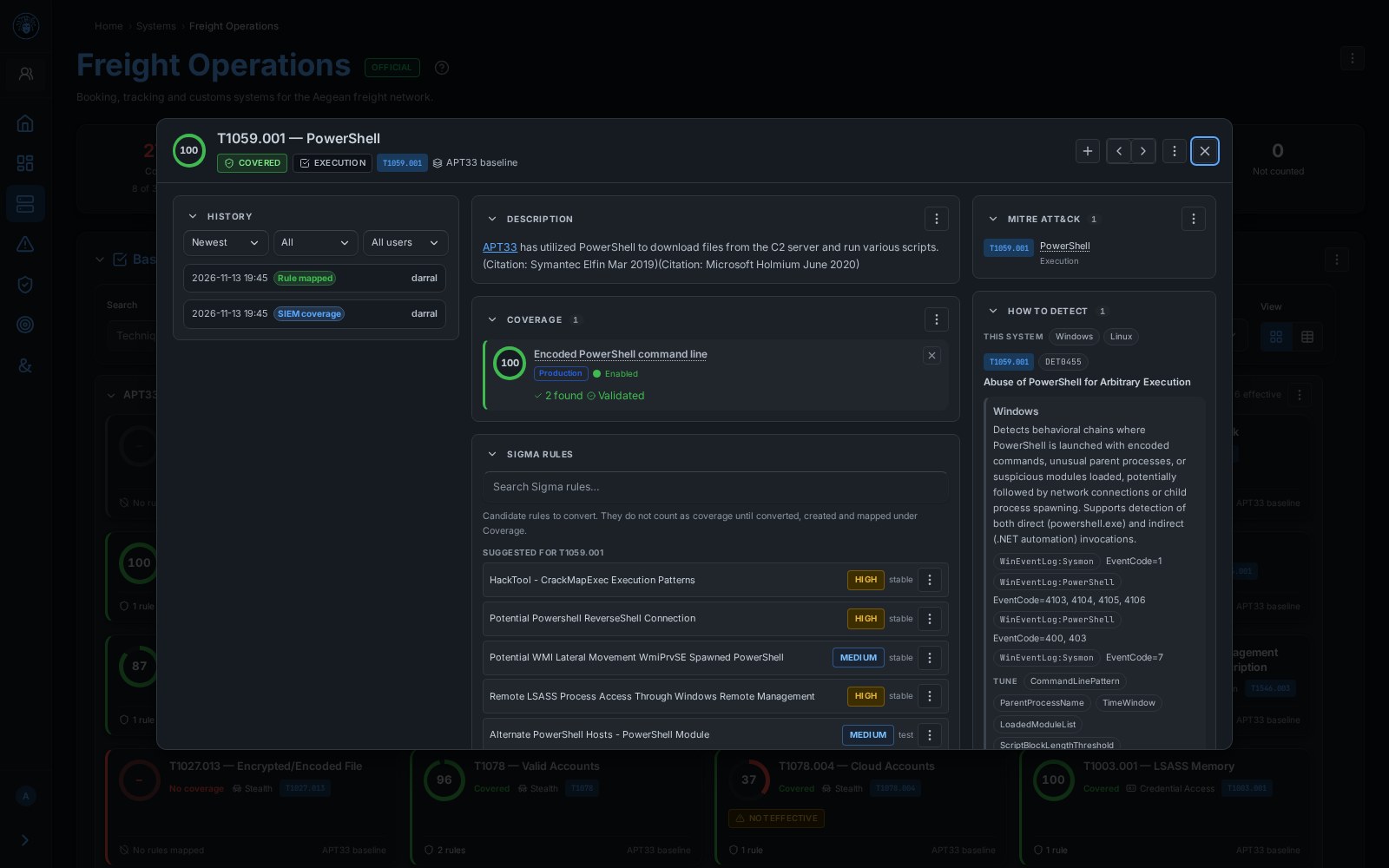
How to detect, in a technique's window
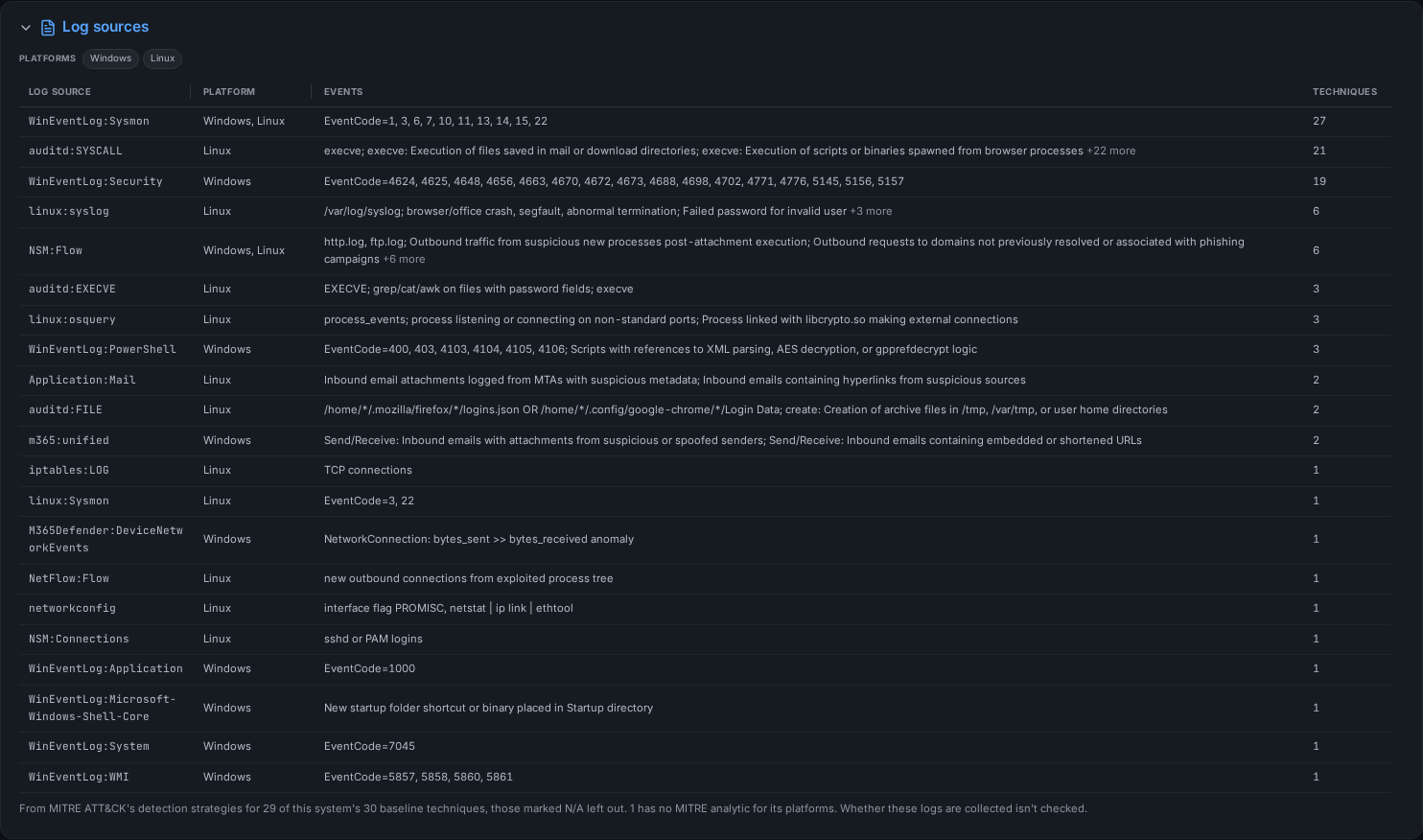
The log sources a system needs
Architecture
Two containers, no external database, nothing fetched at runtime.
Nginx
TLS termination, security headers and static files.
FastAPI and HTMX
Server-rendered pages: fast, auditable and without a heavyweight JavaScript front end.
DuckDB
Embedded analytics: reference data built into the image, a control-plane database, and one database per client, all in one data volume you can back up and move.